John Karanja
Ask Request a review

Edition General, change it on the contents page

Know what to fix in your system before you build further.

This copy opens at: money moving through a product

This copy opens at: AI doing real work

This copy opens at: a technical lead you can trust

This copy opens at: investing in or buying a product

This copy opens at: a team learning AI agents

A short book for founders, teams and investors: products that move money or put AI to work, and the technical lead, the due diligence or the training that goes with them.

by John Wainaina Karanja · building software since 2007 · UTC+3

@qwainaina reads “cue Wainaina”: my middle name, written as music.

Free inside: 16 rules for systems people trust

Your edition

Which is closest to your work?

The questions, the sample and the offer follow your choice. You can change it here at any time.

The short version · 30 seconds

The whole book on one spread.

John Karanja

I'm John Wainaina Karanja, a product and systems lead. I work remotely, in UTC+3. I design the systems a business runs on, and I lead the build.

What I do
I review one system for a fixed price. You learn what works, what could break, and what to fix first. If you want, I then lead the work.
For whom
Founders whose product moves money or puts AI to work; anyone who needs a steady technical lead; investors before they sign; teams learning to build with AI agents.
Proof
Products I built and run: Melanin, Nyukia and Space.ke. Opening keynote at the World Blockchain Summit Nairobi, 2018.
Free inside
16 rules for systems people trust, each with three questions for your team. Read the rules
How it runs
A fixed price, and about 10 to 15 days for a review. I only need read-only access. You get a written report and a call to go through it. Hire me for the fixes within 60 days and the fee counts towards them.
John Karanja

John Wainaina Karanja · UTC+3

Before we begin · the author

I design the systems a business runs on, and lead their delivery.

  • 2007Founded Space Kenya Networks, a software and web services company.
  • 2016Founded BitHub Africa, a blockchain accelerator in Nairobi; trained teams, advised founders and spoke at industry events.
  • NowI build and run my own products in payments, mining, language and research. They are in chapter four.
  • Alias@qwainaina, read as “cue Wainaina”. A cue is a musician's signal to start playing. My logo is my middle name, written as music.
  • StudyMaster's, University of Oxford. Bachelor's, Strathmore University.

Public record

Reviews are a new offer. The sample in chapter two shows exactly what you get.

Chapter one · five questions

Five questions before you build further.

It takes a minute. Answer as things are today; "not sure" is an honest answer.

1 2 3 4 5

Nothing is stored or sent. Your answers stay on this page unless you choose to send them.

  1. For each important fact, is there one record that counts?
  2. Can you release a small change and undo it the same day?
  3. If a request times out, does the system know whether it happened?
  4. Do tests decide when a piece of work is done?
  5. Could a new developer explain the main flow from one diagram?
  1. If the connection drops mid-payout, can you tell whether the payment went out?
  2. Is each payout written into your records before it is sent?
  3. Do you confirm an incoming payment at its source, not from the browser?
  4. Can you match every balance you show to its source?
  5. If the same statement or event arrives twice, is the second one refused?
  1. Does it only read and act on sources you have approved?
  2. Do you have test cases with known good outcomes?
  3. When it is unsure, does a person decide?
  4. Can you see which source or step each output came from?
  5. Is there a written list of what it must never do?
  1. Could someone outside your team explain how the product is built from what is written down?
  2. If your main developer left tomorrow, could someone else ship a change next week?
  3. Do you know which part of the system would break first if usage doubled?
  4. Is one person accountable for technical decisions, with time to make them?
  5. Do releases follow a checklist, with a way back if something breaks?
  1. Have you seen the product's code and infrastructure, not just a demo?
  2. Do you know who owns the code, the cloud accounts and the domains?
  3. Could the product keep running and changing if its founding developer left?
  4. Do you know what the product costs to run each month, and why?
  5. Has anyone checked the pitch's technical claims against the system itself?
  1. Does your team use AI coding agents with agreed rules for what they may change?
  2. Are agent-written changes reviewed with the same checks as human ones?
  3. Does your team share prompts, rules and lessons, rather than each person working alone?
  4. Can your team explain how its own agent workflows decide and act?
  5. Has anyone on the team built and shipped one agent workflow end to end?
Chapter one · your reading

Your reading

Answer the five questions first; your reading appears here.

    This is a self-check, not a finding. A review checks each answer against evidence.

      Go to the questions

      Chapter two · a sample review

      What you would receive

      Illustrative sample · a fictional system, not a client's

      Every review starts with a map of the system as it is today. Numbered pins show where the risks are. The next page explains each pin and what to do.

      A real review runs to several pages. The full sample is linked on the next page, to read or download.

      Payment-state map: a rewards app that pays out in cryptocurrency
      1. Player answers
      2. Score servicekeeps its own balance
      3. Reward claim
      4. Payout sendersends before it claims
      5. The chaintimeouts retried blind
      Workflow and control map: an agent that drafts supplier payments from emailed invoices
      1. Shared inboxreads every sender
      2. Invoice reader
      3. Draft paymentno test cases
      4. Approvalapprover sees only the total
      5. Ledger
      Current-state diagram: a marketplace built quickly with AI help, now with paying users
      1. Web app
      2. APIdeployed by hand
      3. Databaserestore never tested
      4. Payments provider
      5. One laptopholds every key
      Evidence map: a small software business before an acquisition
      1. Seller's deckclaims "real-time"
      2. Code repositoryowned by a former contractor
      3. Hosting accounts
      4. Customer datarestore never tested
      5. Handover
      Workshop outline: AI coding agents in a five-person team, one day
      1. How agents fail
      2. One workflow, hands-onbuilt together
      3. Rules and review gateswritten for your repo
      4. Your own codebase
      5. Next month's planwho does what
      Chapter two · findings and brief

      Each pin, explained

      A payout can be sent twice High

      Evidence: the sender retries after a timeout, and nothing records that the request was already sent.

      Change: write each request down before sending. A retry checks that record first. Rule 04: Make actions safe to repeat

      A timed-out payout has no owner High

      Evidence: timeouts are logged, with no state a person can review.

      Change: mark it "uncertain" and check the chain before any retry. Rule 10: Expect other services to fail

      Two records hold one balance Medium

      Evidence: the score service and the payout table each keep a total. Unknown: how often they have differed.

      Change: choose one record that counts, and work the other out from it. Rule 01: Keep each fact in one place

      The agent acts on mail it should not trust High

      Evidence: invoices from any sender are read and drafted, including first-time senders.

      Change: act only on approved suppliers, and match every invoice to a purchase order. Rule 13: Keep AI on a budget and on the facts

      Nobody can say whether a change helped High

      Evidence: there is no set of past invoices with known correct drafts.

      Change: keep 30 past invoices as a test set and run it before each change. Rule 14: Let tests decide when work is done

      Approval is a rubber stamp Medium

      Evidence: the approver sees the amount, not the source invoice or what the agent changed. Unknown: how many drafts were approved unread.

      Change: show the source document and the agent's reasoning beside every approval. Rule 09: Several simple guards beat one clever wall

      One person holds every key High

      Evidence: production access, deploy rights and the domain account sit with one developer.

      Change: a list of who has access to what, a second owner on every account, and automatic releases. Rule 07: Give each part only the power it needs

      No way back from a bad release High

      Evidence: changes are copied to the server by hand; there is no previous version to return to.

      Change: automatic releases that can go back to the last version in one step. Rule 15: Ship only what was checked, and watch it run

      The backups have never been restored Medium

      Evidence: nightly backups exist. Unknown: whether one has ever been restored, and how long it takes.

      Change: a timed restore test, repeated monthly. Rule 14: Let tests decide when work is done

      The code belongs to someone else High

      Evidence: the repository and the cloud account are registered to a former contractor.

      Change: make the transfer of both a condition of signing. Rule 07: Give each part only the power it needs

      "Real-time" is a nightly batch High

      Evidence: the sync job runs once a day; the deck says real-time.

      Change: correct the assumption in the valuation, or require the fix before closing. Rule 14: Let tests decide when work is done

      Customer data has never been restored Medium

      Evidence: backups run nightly. Unknown: whether a restore works, and how long it takes.

      Change: a witnessed restore test before signing. Rule 15: Ship only what was checked, and watch it run

      A shared rule file for your agents

      What: written together during the day, for your own repository.

      You leave with: what agents may change, what they must ask about, and what they must never touch. Rule 13: Keep AI on a budget and on the facts

      One working workflow

      What: built end to end by the team on a real task.

      You leave with: a pattern the team can copy for the next task. Rule 14: Let tests decide when work is done

      A review gate

      What: agent-written changes pass the same checks as human ones. Unknown: which checks your pipeline already runs.

      You leave with: a pull-request checklist for agent work. Rule 15: Ship only what was checked, and watch it run

      What to do first

      1. Write a record with a unique number for each request.
      2. The sender refuses any request without that record.
      3. Done when: a forced timeout never sends twice.

      What to do first

      1. Add an approved-supplier list and purchase-order matching.
      2. Build the 30-invoice test set and record today's results.
      3. Done when: an invoice from an unknown sender is never drafted.

      First 30 days · the plan

      1. Week one: a list of who has access, and a second owner on every account.
      2. Weeks two and three: automatic releases you can undo in one step.
      3. Done when: last night's backup is restored, timed and written down.

      Conditions before signing

      1. Ownership of code, accounts and domains transferred at signing.
      2. A witnessed restore of customer data.
      3. The "real-time" claim corrected in the sale documents.

      The day · at a glance

      1. Morning: how agents fail, and one workflow built together.
      2. Afternoon: rules and review gates on your own codebase.
      3. Afterwards: a one-page plan for the next month.

      Findings keep what the evidence shows apart from what is still unknown. The plan is written so your own team, or any other, can act on it.

      Read the full sample report · PDF

      Read the full sample report · PDF

      Read the full sample report · PDF

      Read the full sample report · PDF

      Read the full sample workshop pack · PDF

      Chapter three · the rules behind it

      16 rules for systems people trust

      These are the rules I build by. In a review, every finding names the rule it breaks. Choose a cell to read one.

      All 16 rules as full pages

      Rule 01 of 16

      Keep each fact in one place

      Decide where each important fact lives, and let everything else read it from there.

      Without it: A customer's balance shows one figure in the app and another in the payout table. Support cannot answer, and the books cannot be trusted.

      Ask your team

      1. For each important fact, can you name the one record that counts?
      2. If two records disagree, does anything warn you?
      3. Could a new developer find where a price or a balance is stored within an hour?

      Read the full rule Request a review

      Chapter four · the work

      What I have built

      I'm John Wainaina Karanja, a product and systems lead. I design, lead and deliver. If a specialist is needed, we agree that first.

      Three products by name. The systems behind my other work, by what they do. The honey is the benefit I aim for, not a promise.

      What I don't do: I don't write or audit smart contracts, train AI models from scratch, or give investment advice. I plan around them and work with the specialists who do.

      Energy and Bitcoin mining

      Melanin

      The Melanin home page: put spare energy to work, for homes, farms and data centres

      Turns spare electricity into Bitcoin mining: a mining pool, and Melanin Click, an app that mines to your own wallet from a computer, a Raspberry Pi board or a phone.

      HoneyPower that would be wasted becomes value, with rewards people can inspect.

      1. Device
      2. Pool
      3. Counting each miner's work
      4. Building the block
      5. Payout
      Trivia and rewards

      Nyukia

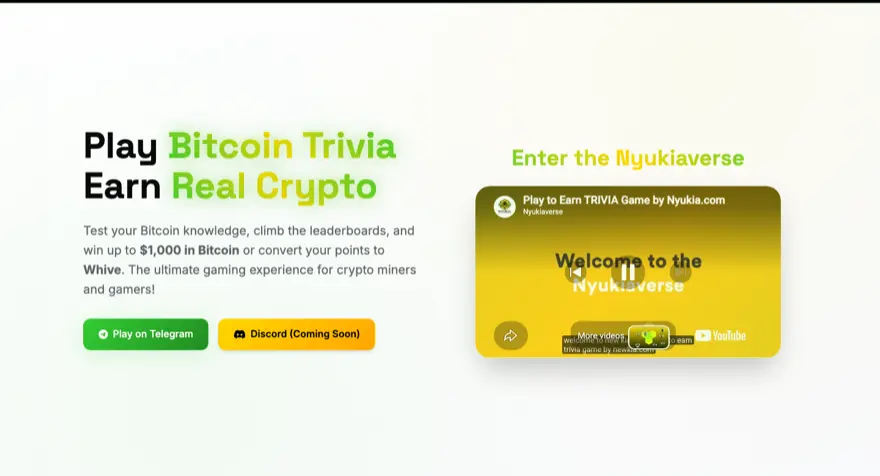
      The Nyukia home page: play Bitcoin trivia, earn real crypto

      A Bitcoin trivia game with scoring, leaderboards and cryptocurrency reward payouts.

      HoneyLearning that connects game progress with a traceable reward process.

      1. Answer
      2. Score
      3. Claim the reward
      4. Send the payout
      5. Reconcile
      Property · advisory

      Space.ke

      The Space.ke home page: verified video tours of Kenyan property

      Verified video tours of Kenyan property before you enquire. An assistant answers only from the site, and passes you to a person when needed.

      HoneyBuyers find relevant answers and reach a person when a question needs judgement.

      1. Site content
      2. An assistant that answers from the site
      3. Answer checks
      4. A person takes over
      System · on-chain intelligence

      Chain intelligence service

      Tracks wallet and token activity on a public blockchain, explains what large holders do, and sends alerts. Paid plans open only after the payment is confirmed on the chain.

      HoneyPublic data made readable, with payment treated as its own control.

      1. Chain data
      2. Chain reader
      3. Analysis
      4. Payment check
      5. Research view
      System · AI agents

      Agent operations system

      Scheduled AI agents that do real office work: they read mail and records, draft replies and reports, keep a record of decisions and tasks, and raise only urgent alerts. A person approves anything that leaves.

      HoneyRoutine work done every day, with people deciding what matters.

      1. Sources
      2. Agents
      3. Drafts
      4. Human approval
      5. Action
      System · finance automation

      Finance back-office

      Reads bank and mobile-money statements into the books of several companies, checks they match, links every figure to its source, and tracks filing deadlines.

      HoneyBooks you can trace, and deadlines you see coming.

      1. Bank statements
      2. Double-entry ledger
      3. Reconciliation checks
      4. Human review
      System · protocol

      Mining protocol

      A digital currency anyone can mine on an ordinary computer: its own chain, wallets and mining software, and a reward token other products pay out in.

      HoneyAn open way in for people without mining hardware.

      System · education and voice

      Voice-first language tutor

      Speech practice for an African language, with spaced practice and answers from checked sources. Draft material stays apart from approved lessons.

      HoneyPractice material that stays connected to its sources and review status.

      1. Candidate material
      2. Linguistic review
      3. Admitted content
      4. Speech practice
      System · research

      Research framework

      Scores new technologies on several measures, records where each fact came from, and compares signs with history before a decision.

      HoneyAssumptions and evidence that are easier to inspect.

      Chapter five · how a review runs

      How a review runs

      1. You tell me what the system does and the decision you need to make.
      2. We agree the scope, the materials and the dates in writing. Nothing starts before that.
      3. You give read-only access, or a sample with private details removed. The days start when access works.
      4. I review, then send the written report.
      5. We go through it on a call, and I answer one round of follow-up questions.

      Access and confidentiality

      I only need read-only access. Never send passwords or live keys. I sign your confidentiality agreement, or you can use mine. I delete your materials on a date we agree.

      If I find little wrong

      Then the report says so, with the evidence. Proof that a system is sound is useful, to you and to anyone you show it to.

      Who does the work

      I do the review myself. Nothing is handed to a junior.

      Chapter five · the offer

      Architecture review

      USD 2,450Fixed · 10 hours at USD 245 an hour · ready in about 10 days

      Find out where your system is sound, where it is fragile and what to change first. One application, the most important thing your users do in it, and the services it connects to.

      Hire me for the follow-on work within 60 days and the full fee counts towards it.

      Start smaller A 90-minute working session on one question, USD 300, which counts towards the review.

      Go further If you want help building it: the work in reviewable phases, quoted after the review.

      Payments and ledger integrity check

      USD 2,450Fixed · 10 hours at USD 245 an hour · ready in about 14 days

      Find where a payment could be lost, repeated or recorded wrongly. One payment or payout flow and its ledger trail, traced with a sample that has private details removed. No live payments.

      Hire me for the follow-on work within 60 days and the full fee counts towards it.

      Start smaller A 90-minute working session on one flow, USD 300, which counts towards the check.

      Go further Then the fix phase, and monthly reconciliation support if you want it, quoted after the check.

      AI readiness review

      USD 2,450Fixed · 10 hours at USD 245 an hour · ready in about 10 days

      Find out if an AI workflow is ready for a small, limited trial, what to prove first, and how people stay in control when it goes wrong.

      Hire me for the follow-on work within 60 days and the full fee counts towards it.

      Start smaller A fixed setup audit of one workflow you already run, USD 1,000.

      Go further Then a trial build, and monthly help from USD 5,000 a month (about ten hours a week) if you want it.

      Architecture review or handover check

      USD 2,450Fixed · 10 hours at USD 245 an hour · ready in about 10 days

      Before you hand me, or anyone, the keys: a clear account of how the product is built, who holds what, what breaks first, and a plan for the first 30 days.

      Hire me for the follow-on work within 60 days and the full fee counts towards it.

      Start smaller A 90-minute working session on the decision in front of you, USD 300, which counts towards the review.

      Go further Then a part-time technical lead: from USD 5,000 a month, about ten hours a week.

      Technical due diligence

      USD 4,500Fixed · a product with 1 to 2 developers · about 15 days

      A clear account of the technical risks, open questions and handover difficulties before you buy, invest in or partner with a product. Larger codebases are quoted separately.

      Hire me for the follow-on work within 60 days and the full fee counts towards it.

      Start smaller A 90-minute working session on the deal in front of you, USD 300, which counts towards the diligence.

      Go further After the deal: a technical plan for the first 90 days, quoted separately.

      One-day hands-on workshop

      USD 2,000Fixed · one day, up to 10 people, online or on site

      Your team builds one AI-agent workflow end to end on its own codebase, and leaves with rules, a review gate and a plan.

      Hire me for the follow-on work within 60 days and the full fee counts towards it.

      Start smaller A 90-minute briefing for leaders, USD 300, which counts towards the workshop.

      Go further Then 4 to 12 weeks of coaching for the team, quoted per team.

      You get

      • A labelled diagram of the system as it is
      • Findings, most important first, with evidence and what is still unknown
      • A recommended design, with its pros and cons
      • A short plan, in order, your team can act on
      • A call to go through it, and one round of questions

      Not included: code changes, deployment, load or penetration testing, security certification.

      Checked against rules 01, 03, 05, 07, 15 of the field guide.

      You get

      • A payment-state map
      • Findings you can trace, and the evidence that is missing
      • A list of failure cases to test
      • Fixes in order, each with a "done when" check
      • A call to go through it, and one round of questions

      Not included: financial audit, tax or accounting opinion, smart-contract audit, handling passwords or keys, moving funds or building the fixes.

      Checked against rules 04, 06, 10, 11, 12 of the field guide.

      You get

      • A short report that keeps evidence apart from guesses
      • A map of the workflow and who approves what
      • A trial plan: what counts as success, and when to stop
      • Next steps, in order
      • A call to go through it, and one round of questions

      Not included: training AI models, access to live systems, legal advice on data rights, or promises about accuracy or returns.

      Checked against rules 13, 03, 09, 14 of the field guide.

      You get

      • A diagram of the system today, and a list of who has access
      • Findings, riskiest first, with evidence and what is still unknown
      • A plan for the first 30 days
      • What a part-time technical lead would own, week by week
      • A call to go through it, and one round of questions

      Not included: code changes during the review, security certification, hiring or employment terms.

      Checked against rules 01, 07, 12, 15, 16 of the field guide.

      You get

      • A risk report, each point linked to its evidence
      • Checked facts kept apart from seller claims and missing evidence
      • Questions for the technical team
      • Conditions to set before signing, and a handover outline
      • A call to go through it, and one round of questions

      Not included: valuation, investment advice, legal ownership opinion, financial audit, exhaustive code or security audit.

      Checked against rules 07, 01, 14, 15 of the field guide.

      You get

      • A short pre-call to choose the task and the codebase
      • A full day, hands-on, on your own code
      • A shared rule file and a review checklist
      • A one-page plan for the next month
      • One follow-up call two weeks later

      Not included: building your product, tool licences, model training or certification.

      Checked against rules 13, 14, 15, 16 of the field guide.

      Paid by USD invoice before the work starts, or through Upwork, which holds the payment until the work is done. Prices exclude any taxes that apply to you.

      The last page · your request

      What is the next decision your system needs?

      Five short answers. I reply within two working days, and nothing starts before we agree the scope in writing.

      1. You send the request below, or write in your own words.
      2. I reply with a short scope note and dates, or an honest "not a fit" and where I would look instead.
      3. We agree scope, materials and read-only access. Then the review is booked.

      Please leave out passwords and production credentials. Nothing you type here is sent or stored by this page: it only opens your own email. Privacy

      Or write to info@johnkaranja.com

      Prefer a platform? Discuss your brief on Upwork.

      The end. Or the first page of yours.

      An old soul who builds new things. When the wood is quiet, I make music.

      Colophon

      How this book was made

      Set in Fraunces and Lora, with original bee and honeycomb drawings. Written, designed and built by John, and served from his own server with no third-party trackers. The logo, qwainaina, reads “cue Wainaina”: my middle name written as a musical score, one bar for each letter.

      Behind the book, my name runs along a stave of music, and a bee dances across it. Bees dance to show the hive where the honey is. This book does the same for your system.

      Read this book as a plain pageAll offers on one pageHow my name became musicThe field guidePrivacy

      © 2026 John Wainaina Karanja · X · LinkedIn · GitHub